
A Personal Connection with Alzheimer’s Disease
My mother had Alzheimer’s disease. I clearly remember the day when my brother and I confronted her about her declining cognitive status. She was furious and wouldn’t believe us. Within a year she needed a full-time caregiver. We kept her in her home as long as we could- about 2 years. We eventually moved her into a memory care facility where she lived for another 2 years. She died in March of 2020- a week before COVID lockdown started.
What is cartilage again?
I remember doing lots of reading about Alzheimer’s and dementia. I had mentally prepared myself for the moments when my mom might no longer know who I was. I thought this would be the hardest part of the disease to experience.
Early in her disease I recall taking her out for a burger and fries. We were eating and I was discussing a health problem that a family member was having. I mentioned the word cartilage. For background, my mom was a working nurse and health care provider for almost 50 total years. She was the mom who would always ask detailed question about any health issue in the family. She was incredibly knowledgable and was always a helpful resource for our family.
So when my mom leaned forward and asked, “What is cartilage again?”…I was caught completely off guard. I had armored myself for the moment when she might not know me…but I hadn’t prepared myself for her losing access to her basic knowledge of medicine, human anatomy, and biology.
She asked, “Are you OK?” I quickly realized that I was just sitting stunned in front of her at Burgerville and I had started crying. I attempted to pull myself together and made some lame excuse for my emotions as I wrestled with this new development. The loss of cartilage became a marker for me of the depth of my mother’s disease. If she’d lost cartilage…then she’d lost a lot. A foundational aspect of my mom’s identity was now gone. It was a challenge to reconcile.
Learning about Alzheimer’s Disease
When I stumbled on the curriculum resources on Alzheimer’s disease from the Allen Institute I was impressed with the design of the lessons. This is a disease that affects many families and that most students have some knowledge about- it’s a relatable and relevant phenomenon. As someone with a personal connection to this disease, I’m excited to share these tools with you. I’m also hopeful that the more diverse minds we get working on this problem the more likely we can solve the puzzle.
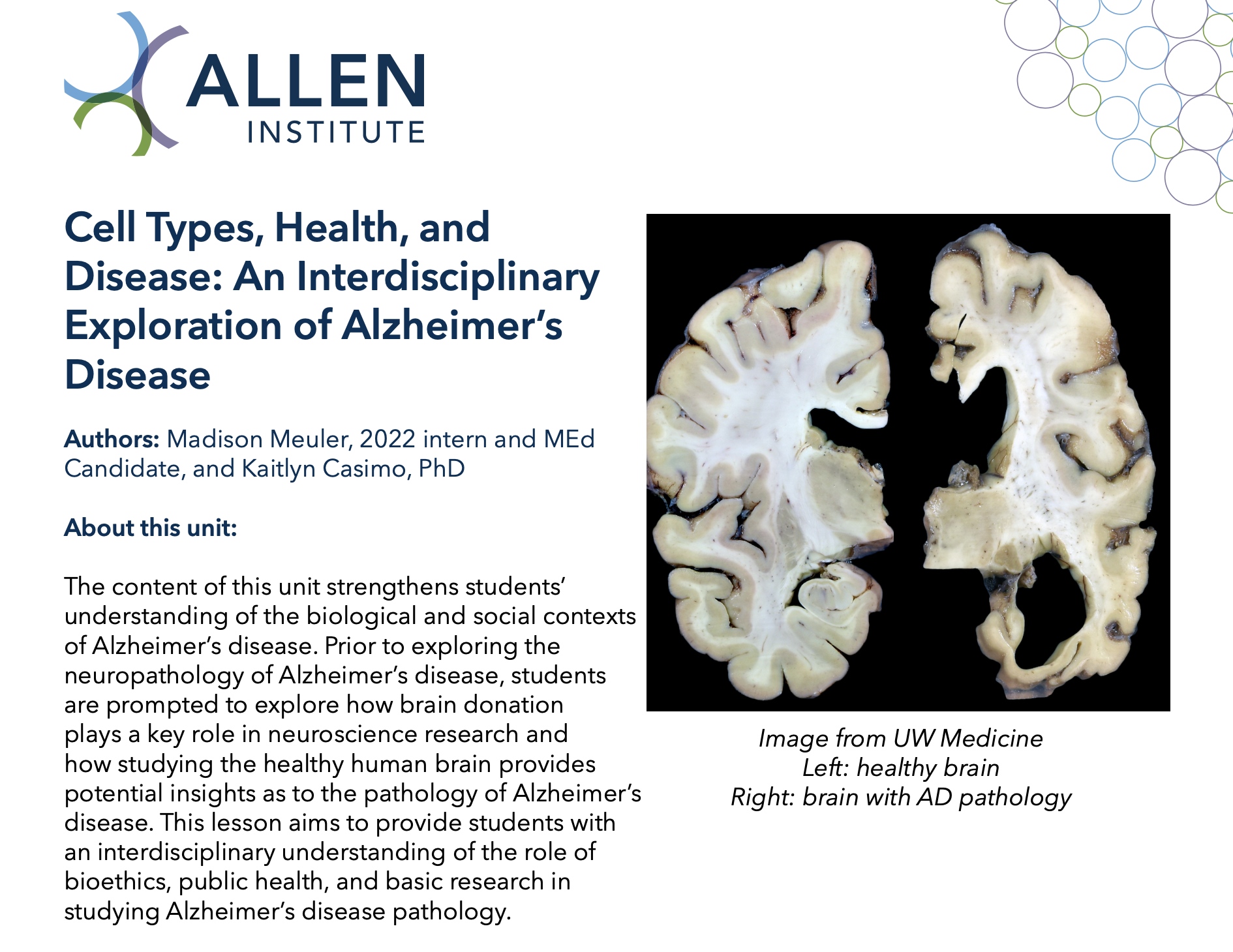
The set of four lesson plans from the Allen Institute takes students on a journey into how scientists use donated brain tissue to explore the differences between a healthy brain and one affected by Alzheimer’s disease. As they go through the lessons, students will dive into both the social and biological sides of Alzheimer’s. They’ll examine data from individual brain cells to see how the genes they express compare to those of neighboring cells. Plus, there’s an interactive image dataset of brain tissue marked with specific indicators, giving students a chance to spot the biological signs linked to Alzheimer’s disease.
This material is perfect for college students in introductory to intermediate cell science or neuroscience courses, as well as advanced high school students in an AP or IB biology course.
Click HERE to access more information and to download the FREE Understanding Alzheimer’s Disease curriculum.

 Science for All
Leave a comment